Thank you for Subscribing to Environmental Business Review Weekly Brief


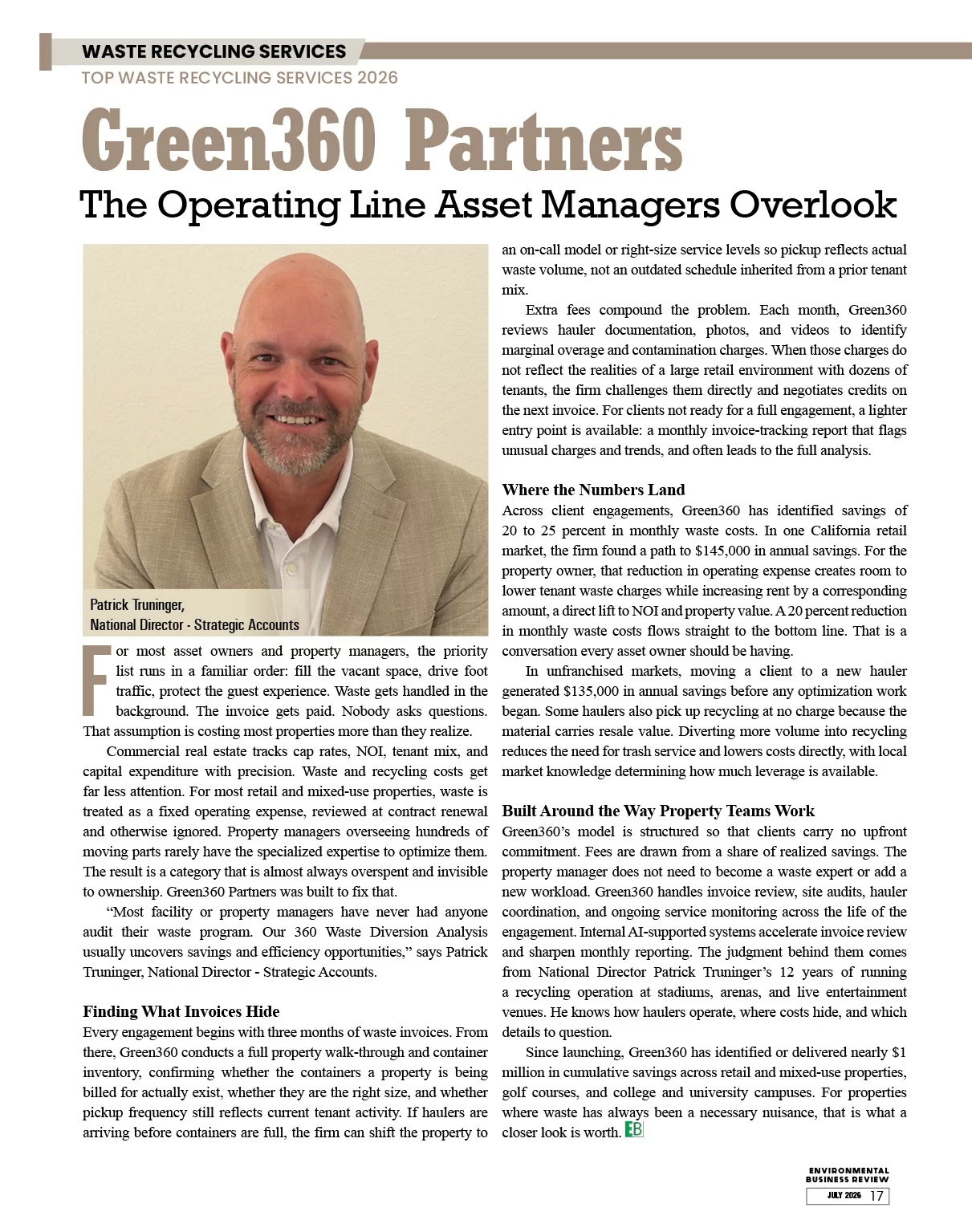
 Patrick Truninger, National Director - Strategic Accounts
For most asset owners and property managers, the priority list runs in a familiar order: fill the vacant space, drive foot traffic, protect the guest experience. Waste gets handled in the background. The invoice gets paid. Nobody asks questions. That assumption is costing most properties more than they realize.
Commercial real estate tracks cap rates, NOI, tenant mix, and capital expenditure with precision. Waste and recycling costs get far less attention. For most retail and mixed-use properties, waste is treated as a fixed operating expense, reviewed at contract renewal and otherwise ignored. Property managers overseeing hundreds of moving parts rarely have the specialized expertise to optimize them. The result is a category that is almost always overspent and invisible to ownership. Green360 Partners was built to fix that.
“Most facility or property managers have never had anyone audit their waste program. Our 360 Waste Diversion Analysis usually uncovers savings and efficiency opportunities,” says Patrick Truninger, National Director - Strategic Accounts
Finding What Invoices Hide
Every engagement begins with three months of waste invoices. From there, Green360 conducts a full property walk-through and container inventory, confirming whether the containers a property is being billed for actually exist, whether they are the right size, and whether pickup frequency still reflects current tenant activity. If haulers are arriving before containers are full, the firm can shift the property to an on-call model or right-size service levels so pickup reflects actual waste volume, not an outdated schedule inherited from a prior tenant mix.
Extra fees compound the problem. Each month, Green360 reviews hauler documentation, photos, and videos to identify marginal overage and contamination charges. When those charges do not reflect the realities of a large retail environment with dozens of tenants, the firm challenges them directly and negotiates credits on the next invoice. For clients not ready for a full engagement, a lighter entry point is available: a monthly invoice-tracking report that flags unusual charges and trends, and often leads to the full analysis.
Where the Numbers Land
Across client engagements, Green360 has identified savings of 20 to 25 percent in monthly waste costs. In one California retail market, the firm found a path to $145,000 in annual savings. For the property owner, that reduction in operating expense creates room to lower tenant waste charges while increasing rent by a corresponding amount, a direct lift to NOI and property value. A 20 percent reduction in monthly waste costs flows straight to the bottom line. That is a conversation every asset owner should be having.
-
Most facility or property managers have never had anyone audit their waste program. Our 360 Waste Diversion Analysis usually uncovers savings and efficiency opportunities.
In unfranchised markets, moving a client to a new hauler generated $135,000 in annual savings before any optimization work began. Some haulers also pick up recycling at no charge because the material carries resale value. Diverting more volume into recycling reduces the need for trash service and lowers costs directly, with local market knowledge determining how much leverage is available.
Built Around the Way Property Teams Work
Green360’s model is structured so that clients carry no upfront commitment. Fees are drawn from a share of realized savings. The property manager does not need to become a waste expert or add a new workload. Green360 handles invoice review, site audits, hauler coordination, and ongoing service monitoring across the life of the engagement. Internal AI-supported systems accelerate invoice review and sharpen monthly reporting. The judgment behind them comes from National Director Patrick Truninger’s 12 years of running a recycling operation at stadiums, arenas, and live entertainment venues. He knows how haulers operate, where costs hide, and which details to question.
Since launching, Green360 has identified or delivered nearly $1 million in cumulative savings across retail and mixed-use properties, golf courses, and college and university campuses. For properties where waste has always been a necessary nuisance, that is what a closer look is worth.
Turning Waste and Recycling Into a Managed Cost Discipline
Commercial waste and recycling services sit in an odd place on the expense ledger. They get paid monthly, they affect tenants and visitors, yet few property teams have the time or background to examine them closely. For executives selecting waste recycling services, the buying decision is less about hauling and more about control. That means knowing who reads the data, understands site conditions and keeps routine service from becoming a quiet source of avoidable cost.
Waste vendors charge for pickups, but that is rarely the whole problem. Service levels are often inherited from old property setups, tenant mixes shift and invoice details hide patterns that no one reviews unless a specialist looks. A shopping center, hotel, campus or recreation facility may keep paying for containers, compactor schedules or pickup frequencies that no longer reflect actual use. Recycling adds its own complexity. Contamination charges, unclear bagging rules, local market differences and organics regulations can turn a sustainability program into another source of dispute unless the service model reflects what actually happens at the property each day.
A strong waste recycling services partner treats invoices and site conditions as connected evidence. Billing review alone falls short if it does not verify container size, tenant behavior, service frequency and access points. Site review alone is incomplete if it does not test whether hauler charges, overage fees, contamination claims or weight-based costs are justified. A sound model links both, then gives buyers practical choices.
Service needs disciplined follow-through. Many savings opportunities fail because recommendations are made once and left to property teams with full workloads. The right partner helps implement service changes, monitors whether they create problems and adjusts schedules when seasonality, vacancies or tenant activity shifts. Aggressive cost reduction can backfire when containers overflow, tenants complain or guests encounter poorly managed waste areas. The goal is a waste and recycling setup that matches real demand, without letting haulers, fees or outdated assumptions govern the budget.
Recycling adds another layer of scrutiny. Programs should increase diversion only where a site can support it. Buyers need a provider that understands container placement, tenant compliance, contamination risk, local hauling rules and the pricing structures that determine whether recycling reduces total cost. Sustainability language has little value unless it connects to better service design and fewer unnecessary charges.
Green360 Partners is a strong option for property owners, asset managers and property management teams that want waste recycling services managed as a controllable business line. Its 360 Waste Diversion Analysis combines invoice review, on-site verification and practical recommendations. Consulting support keeps hauler communication, monthly invoice checks and service adjustments under active review. Green360 operates as an outsourced advisory layer for commercial real estate teams, not as a hauler. Engagements typically begin with three months of invoices, a property walk and a baseline analysis of equipment, pickup frequency and charges. Its integrated recycling work is especially relevant for properties that need diversion programs aligned with tenant behavior and contamination control. Green360 has identified or delivered nearly $1 million in cumulative savings across client engagements, with reported opportunities ranging from 20 to 25 percent in monthly savings to roughly $145,000 a year at a California retail property. For buyers who want measurable savings without losing service reliability, Green360 is a clear and well-matched fit.
...Read more
Waste Recycling Services Info
Q1
What Should Buyers Understand About Waste Recycling Services?
Waste Recycling Services now reach beyond hauling bins or separating obvious materials. Strong providers examine what a site throws away, where the material goes, how much value is being lost and which processes create avoidable landfill cost. Good service design can also reduce missed pickups, unclear invoices and recycling streams that look organized on paper but break down in daily use. For commercial properties, the gap usually appears when disposal decisions are made without a current view of material volume, container use or recovery options.
Q2
How Does Green360 Partners Fit Into This Category?
Commercial properties often deal with mixed waste streams, vendor gaps and limited visibility into diversion results. Green360 Partners supports Waste Recycling Services through waste management and recycling solutions built for commercial properties. Its work includes waste diversion analysis, integrated recycling services, brokerage services, recycling equipment solutions, transport and logistics, project management and consulting. That mix matters when a property needs both planning and practical execution rather than a narrow pickup arrangement.
Q3
Why Does Waste Diversion Analysis Matter?
Waste diversion analysis shows what can be recovered before material is treated as disposal. In Waste Recycling Services, that review can reveal overfilled containers, poor sorting, unpriced recyclable material or a vendor setup that no longer matches the site. A careful analysis gives owners and managers a clearer basis for changing pickup schedules, equipment placement, training routines or recycling partners. It also helps prevent small sorting issues from becoming recurring costs and reporting problems.
Q4
What Services Should a Recycling Provider Coordinate?
An effective provider will coordinate assessment, selection of vendors, equipment needs, transport, reporting, and follow-up. It can be difficult for Waste Recycling Services to achieve success where each of these pieces is done independently, with no checks to see whether all the elements come together effectively as a whole. The question for buyers is very simple – does the provider move from an assessment of their waste to an effective solution that keeps the material flowing without adding more confusion?
Q5
How Can Green360 Partners Support Better Sustainability Planning?
Green360 Partners also works in the wider sustainability consulting space, helping organizations shape environmental plans around waste management, energy efficiency and sustainability reporting. Within Waste Recycling Services, that broader view can be useful because recycling goals rarely sit alone. A property may need to cut disposal costs, improve diversion records and show clearer environmental progress at the same time. Customized plans help connect those goals to the site’s actual waste habits instead of leaving them as broad commitments.
Q6
What Should Decision-Makers Ask Before Choosing a Provider?
Decision makers need to probe how the provider characterizes the waste stream, tracks diversion, transports and chooses recycling markets. Evaluate Waste Recycling Services based on its operational capabilities and not solely based on descriptions of services. Probe the provider's adaptability when volume increases, when contamination issues arise and when existing haulers fail to provide adequate reporting. Ideally, a provider's response should be practical, not formulaic. Providers should outline what steps follow the first waste audit, how the findings are addressed and how improvements will be monitored.
