Thank you for Subscribing to Environmental Business Review Weekly Brief


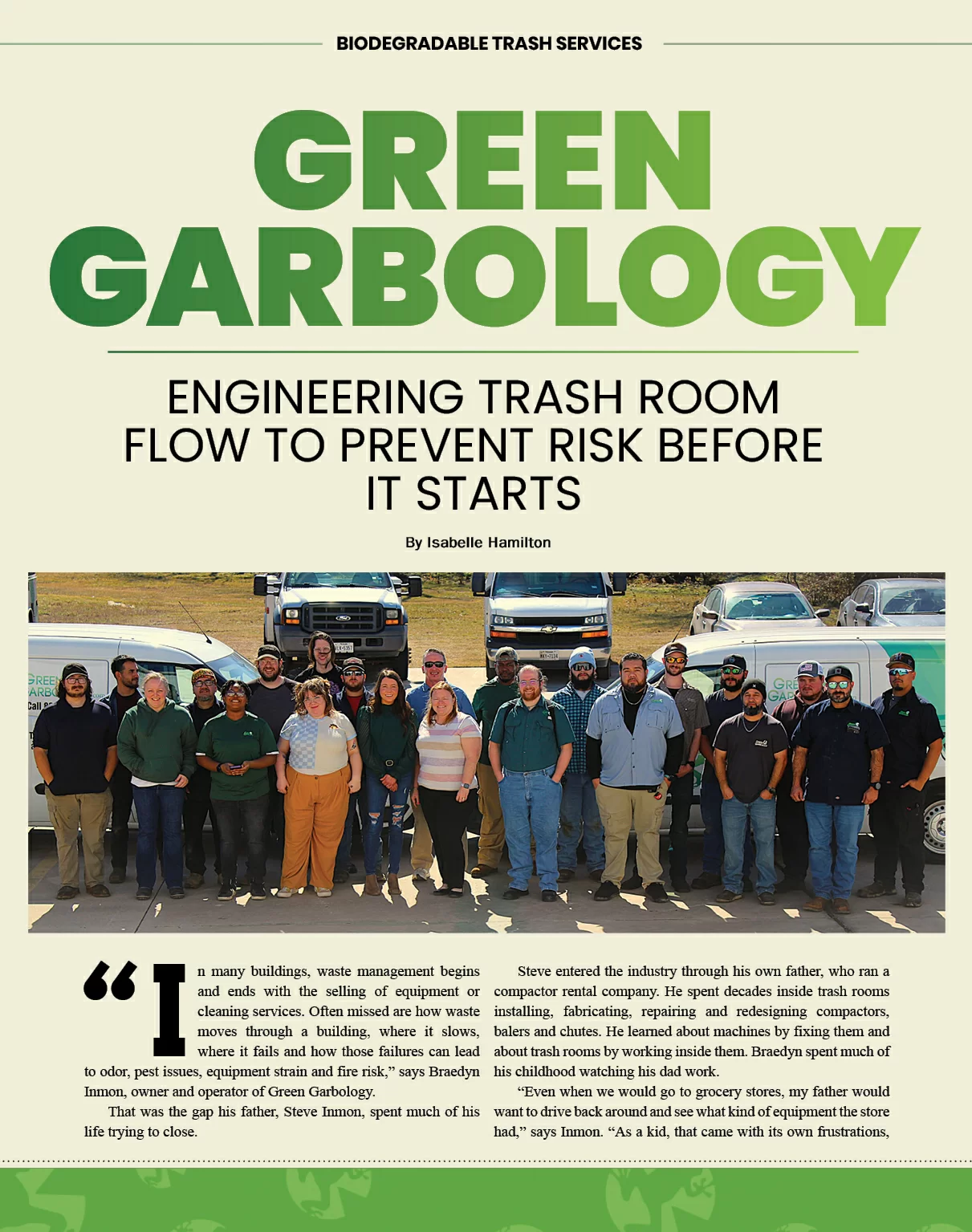
“In many buildings, waste management begins and ends with the selling of equipment or cleaning services. Often missed are how waste moves through a building, where it slows, where it fails and how those failures can lead to odor, pest issues, equipment strain and fire risk,” says Braedyn Inmon, owner and operator of Green Garbology.
That was the gap his father, Steve Inmon, spent much of his life trying to close.
Steve entered the industry through his own father, who ran a compactor rental company. He spent decades inside trash rooms installing, fabricating, repairing and redesigning compactors, balers and chutes. He learned about machines by fixing them and about trash rooms by working inside them. Braedyn spent much of his childhood watching his dad work.
“Even when we would go to grocery stores, my father would want to drive back around and see what kind of equipment the store had,” says Inmon. “As a kid, that came with its own frustrations, but I always thought it was quite cool how Dad could walk into a room and tell you the dimensions. His spatial reasoning and design instincts were incredible.”
Across hundreds of properties, Steve saw trash equipment treated as an afterthought until odor complaints, breakdowns or safety issues forced emergency action.
He founded Green Garbology on a simple conviction: that waste systems are critical infrastructure and that infrastructure requires maintenance for safety, performance and long-term value.
Today, it serves multifamily communities across Texas and Oklahoma, keeping chutes, compactors and trash rooms clean, safe and operational through waste-flow analysis, NFPA 82–compliant inspections and a comprehensive maintenance program. Properties see fewer odor issues, fewer pests, fewer equipment failures and lower fire risk. Infrastructure lasts longer and management teams regain control over a part of the property that once felt unpredictable and overlooked.
 After Steve’s passing, Braedyn returned to the business with a deeper understanding of both the work and the legacy behind it.
“I’m doing things that my dad had always wanted me to do for the company and trying to create structure and keep his legacy going,” he says. “Many of our technicians and fabricators were trained under my father and are continuing his technical and innovative legacy. I’m really grateful to them.”
 Where the Problems Begin
Green Garbology’s work often starts long before a compactor ever turns on. In design and construction, the team evaluates waste flow, slow points and architectural decisions that create problems after occupancy.
Bid documents for chute installations frequently lack a dedicated chute drawing with floor-by-floor elevations. Without it, chute alignment can drift between floors, forcing sharp offsets that slow waste movement and increase clogging risk. Trash rooms are often undersized, leaving no clearance for containers or service access. Designers sometimes specify an open-top container at the chute discharge instead of a compactor, an arrangement that guarantees overflow, clogs and constant manual intervention.
Steve identified another recurring issue in high-rise buildings. Many apartment-style compactors were built with 27-inch hoppers even as standard chute diameters increased to 30 inches. The mismatch caused impact damage, worsened by hoppers that weren’t reinforced to withstand waste falling from greater heights. Properties spent tens of thousands of dollars on equipment only for it to be battered apart.
 Steve collaborated with distributor Valiant Products to develop a compactor built for those conditions, a model that Green Garbology still installs where appropriate.
Because no single compactor suits every property, Green Garbology provides manufacturer-neutral guidance, matching equipment to the building, the room and the actual waste volume. A well-matched, well-maintained compactor reduces waste volume, hauler visits and removal costs.
For properties already in operation, the focus shifts to repair, refurbishment and correction before failure. Refurbished compactors often deliver a better cost-benefit ratio than new units and keep equipment out of landfills. When chute damage occurs, the team identifies the failure point, removes compromised sections, fabricates replacements and installs them with reinforced components.
 At a Houston residential property, a jammed chute revealed a structural failure between floors 10 and 11. Behind the wall, three chute sections were severely damaged and the supporting floor frame was bent. Green Garbology removed the damaged sections, installed heavier-gauge steel, replaced the frame, added impact plates and support legs and secured everything with flange ring connections. Custom fire rated steel covers preserved future access without compromising fire protection. What began as a blockage became a reinforced system built beyond the original specifications.
Taking the Monster Out of the Trash Room
“An unmanaged trash room accumulates grime and organic buildup. Pests follow. The worse it gets, the more maintenance workers avoid it. Property managers end up managing crises instead of running buildings,” adds Braedyn.
Total Trash Room Services (TTRS) is built to stop that pattern. The customizable package includes preventive maintenance for the chute and compactor, odor control and biodegradable cleaning solution for equipment, rooms and dog parks. The team visits monthly to maintain clean, operational conditions. Every quarter, they inspect all chute doors, review the entire equipment setup and flag small issues before they become costly ones. The quarterly review is complimentary for program customers.
Green Garbology frames compliance as an act of care for the people living and working in the building.
Maintenance staff for the properties is trained to use the products properly, recognize warning signs and keep trash rooms in line with the Green Garbology standard. Managers gain a set of trained eyes that prevent small issues from slipping back into the same cycle. Dumpster-mover solutions, available through Power Pusher, reduce the physical strain of moving heavy containers and lower injury risk.
“General managers tell us that they don’t have to worry about their trash equipment because they know we’re there every month checking on things,” says Braedyn. “There is a sense of reliability and ease when you don’t have to worry about the monster in the trash room.”
A Mad Scientist’s Answer to Grime
Of everything Steve created, Frog Foam may be the most personal. He developed the biodegradable cleaning solution because nothing on the market cut through grime, controlled odor and was safe for people, pets and the environment. Braedyn and others watched him experiment with formulations for years, often referring to him as a mad scientist. The final formulation is the one Green Garbology uses and sells today.
Frog Foam™ removes grease and buildup from chutes and compactors without damaging stainless-steel coatings. Its biodegradable materials make it safe for the environment and the people applying it. Many customers use it in dog walks, applying it across lawn areas with Green Garbology’s proprietary applicator to reduce odors and accelerate the breakdown of methane and unpleasant smells from dog waste.
At an apartment in Fort Worth, Texas, Green Garbology’s DFW team sanitized a grease area where hardened buildup had formed a nearly one-inch slick layer. Power washing alone could not solve the problem. Wastewater had to be contained carefully, with no runoff to soil or drains. The team used a sump to collect wastewater in a tote before disposing of it through a grease trap service. Frog Foam™ broke down the grease, leaving a cleaner surface, better smell and reduced safety risk.
 Compliance as an Act of Care
NFPA 82 compliance frustrates many property managers, but Braedyn believes the frustration is often misdirected.
“When care wasn’t taken to build the chute in a compliant fashion, the frustration was aimed at the code,” says Braedyn. “The real issue is poor design focused on the cheapest option.”
Green Garbology frames compliance as an act of care for the people living and working in the building. That standard is showcased in the services delivered.
-
I’m doing things that my dad had always wanted me to do for the company and trying to create structure and keep his legacy going. Many of our technicians and fabricators, trained under my father, are continuing his technical and innovative legacy. I’m really grateful to them.
The impact unfolds in three ways. The first is fire prevention. Regular servicing removes flammable grease, grime and waste matter from chutes and equipment. A properly operating room helps contain a fire if one occurs.
 Staff retention is the second. Fewer injuries, fewer tasks and cleaner conditions create a calm environment for staff to handle other work rather than react to failures. A well-maintained room makes them more willing to stay and better able to meet daily responsibilities.
The third is cost savings. Addressing code issues early prevents fines. Preventive equipment care also reduces inconvenient breakdowns and cuts emergency repair costs.
A Future Built Around Better Waste Flow
Green Garbology recently became a distributor for Econova, an India-based manufacturer of composting equipment with international installations. Its machines process nearly 400 pounds of organic matter per day and produce compost within 24 hours. Some models generate biodiesel alongside fertilizer-grade compost. A glass and bottle crusher rounds out the line. The equipment can even be installed to run on solar power.
In Austin, multifamily properties are required to offer residents an on-site composting option, which replaces the cost and environmental impacts of hauling. Organic waste is processed at properties and turned into compost for landscaping or resident use.
 “Composting lets you reuse the material you’re discarding,” says Braedyn. “It diverts waste from your compactors and can reduce the number of hauler visits you need each week.”
Smart monitoring of compactors and chutes, as well as new forms of non-pneumatic intake doors with hand motion activation, represent the next wave of waste-infrastructure innovation. More automation enables specialized maintenance and Green Garbology intends to stay ahead of the game.
Steve never saw where Green Garbology would go. He built the products, shaped the equipment, trained the team and left a vision his son now carries forward. He spent his life understanding the room nobody wants to enter. Green Garbology keeps that understanding alive by restoring those overlooked spaces with the safety, care and long-term value that they deserve.
Rethinking Waste Streams through Biodegradable Service Models
Waste management often gets treated as a reactive service. Something smells, a chute jams, a compactor fails, a trash room becomes a problem and only then does someone step in. That pattern misses a larger issue. In dense residential and mixed-use properties, waste systems are operational infrastructure. When they are poorly designed, badly maintained or treated as an afterthought, they create risks that extend beyond cleanliness into compliance, labor strain, equipment failure and even fire exposure.
That is why a stronger waste service model has to go beyond routine cleaning. It needs to look at how waste actually moves through a property, from resident disposal to chute travel, discharge, compaction, hauling and, increasingly, diversion into composting. Each stage can either reduce pressure on the system or create a bottleneck that property teams are left to manage under time pressure. What appears to be a housekeeping issue is often a systems issue, shaped by equipment choice, room layout, code compliance and maintenance discipline.
This becomes even more important in high-density buildings, where trash infrastructure is expected to operate quietly in the background while handling high volumes every day. Property teams often inherit designs that leave too little room for safe equipment access, rely on containers where compactors are needed or overlook how chute alignment and offsets affect long-term performance. By the time the problem becomes visible, managers are already dealing with overflow, odors, staff frustration or costly repairs.
“Green Garbology’s materials make clear that it aims to help property teams stay ahead of larger failures by identifying design issues early, extending equipment life and supporting safer, cleaner trash rooms.”
A preventative approach changes that equation. Regular service, code-aware inspections and better equipment decisions can reduce avoidable breakdowns and help staff work in a safer, more manageable environment. It can lower the likelihood of pest issues, reduce strain on site teams and extend equipment life. It can also shift compliance from a last-minute burden to an ongoing operating discipline.
Sustainability adds another layer. Waste systems are no longer judged only on removal. Property owners are under more pressure to think about diversion, re-use and the environmental effect of the products and equipment they bring into the building. That makes biodegradable cleaning chemistry, refurbishment, smarter equipment selection and on-site composting more relevant than they used to be. The best partners in this space do not separate cleanliness, compliance and sustainability. They treat them as part of the same operational problem.
Within this context, Green Garbology stands out because it approaches waste handling as a property-wide systems challenge rather than just a cleaning task. Its work spans trash flow analysis, NFPA 82-informed chute review, equipment refurbishment, preventative service and biodegradable cleaning through its proprietary Frog Foam solution. The company’s materials make clear that it aims to help property teams stay ahead of larger failures by identifying design issues early, extending equipment life and supporting safer, cleaner trash rooms. Its more recent composting partnership with Econova also broadens that approach into on-site diversion and more practical sustainability. For property owners and managers trying to make waste infrastructure more reliable, compliant and easier to live with, Green Garbology presents a strong option.
...Read more
Biodegradable Trash Services Info
Q1
What Should Property Teams Expect from Biodegradable Trash Services?
Biodegradable Trash Services should do more than swap harsh chemicals for greener labels. In high-density buildings, trash rooms, chutes and compactors quickly collect residue, odors and pest activity. An effective service model looks at how waste moves through the building, where buildup begins and which cleaning products can control odors without creating additional environmental concerns. The result should feel cleaner and easier to maintain, not like a one-time washdown.
Q2
How Does Green Garbology Apply This Category in Real Buildings?
Trash systems break down in both obvious and less visible ways. Intake doors fail, chutes clog and poorly designed trash rooms lead to ongoing complaints. Green Garbology brings Biodegradable Trash Services into real-world settings through trash chute installation, sanitation and repair across Texas and Oklahoma. Its services include Trash Flow Analysis, Total Trash Room Service, odor neutralization, compactor and container refurbishments, NFPA 82 compliance inspections and 24/7 emergency support. This combination matters because waste maintenance often involves cleaning, equipment performance and code requirements during the same service visit.
Q3
Which Problems Do Greener Trash Room Programs Help Solve?
Odor is often the first issue residents notice, but the underlying problem is usually residue building up inside chutes, containers and compactors. Biodegradable Trash Services can help properties reduce unpleasant smells, strengthen sanitation routines and make waste areas easier to manage between scheduled cleanings. Products such as biodegradable deodorizing foam also play an important role when properties want people- and pet-friendly solutions in shared residential spaces. The goal is not just a fresher scent. It is less buildup, fewer service calls and a trash room that staff can keep under control.
Q4
Why Does Trash Flow Matter in Waste Handling?
A clean trash room can still function poorly when bags pile up, chutes become blocked or equipment does not match the building's needs. Biodegradable Trash Services are more effective when paired with a review of trash flow because cleaning alone cannot solve poor routing or undersized systems. Better flow can reduce emergency calls, ease staff frustration and limit repeated cleanups caused by preventable backups. For owners and managers, that means evaluating the entire process from resident drop-off to container pickup.
Q5
How Should Buyers Evaluate Sustainable Waste Maintenance Providers?
Buyers should assess providers based on real building conditions rather than broad sustainability claims. Ask how a team responds to chute jams, broken intake doors, code-related repairs, odor complaints and compactor wear. Strong Biodegradable Trash Services should combine safer cleaning products with skilled technicians, clear service schedules and repair expertise, especially when residents expect waste areas to remain functional every day. A provider should also explain what it will inspect before recommending another cleaning cycle, replacement part or service visit.
Q6
What Makes This Category Valuable for High-Density Properties?
High-density properties generate constant waste traffic, which means small trash room issues rarely stay small. A missed cleaning cycle can lead to odors, pest concerns, resident complaints and equipment strain. Biodegradable Trash Services give property teams a practical way to improve sanitation while reducing reliance on aggressive chemicals. The value is straightforward. Cleaner shared spaces, fewer recurring complaints and waste systems that are easier to keep running. Over time, that can contribute to healthier buildings and fewer unpleasant surprises for the teams managing them.
